
WU YIMING 邬一名
b. 1966, works and lives in New York City
Introduction
Wu Yiming, born in Shanghai in 1966, graduated from the Fine Arts Department of East China Normal University, where he received systematic training in traditional Chinese painting and calligraphy, established a solid foundation. Since the early 1990s, he has been engaged in ink painting for nearly three decades. While inheriting the traditions of Eastern ink art, Wu continuously searches for his own way of expression within the long-standing dialogue and collision between Chinese and Western painting. He combines traditional ink techniques with a modern, innovative vision, often drawing inspiration from society and his personal living environment, thereby developing his distinctive artistic language.Yet, we hardly find any representation of social or historical issues in Wu’s “New Ink” series. Between 1996 and 2010, Wu gradually shifted focus from painting into sculpture, using his own material experimentation to negotiate what “contemporary art” meant in that specific historical moment. Meanwhile, he moved from the depiction of others toward an increasingly interiorized inquiry—an attention to the psychic and affective dimensions of the self. During this period, his portraits became more specific, with topics such as bust portraits of friends or particular designers. His technical approach still seemingly casually composed; yet in the shaping of his subjects, Wu’s technique turned away from vague portrayal and became more individuated, marked by psychological density and a pointed spiritual referentiality.
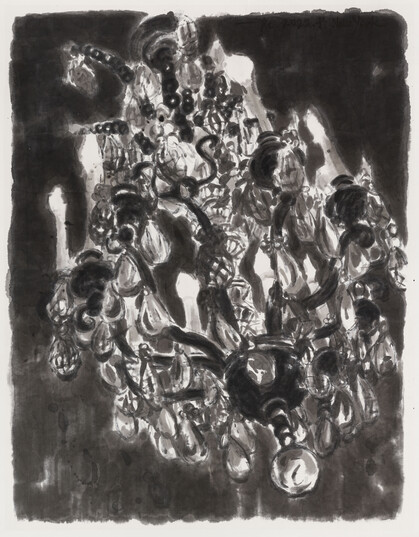
After 2010, the artist shifted focus to mainly still life, and he entered a more markedly personal phase, one that recalls the literati scholars who, in moments of cultivated leisure, projects refined sensibilities onto the elegant objects arranged upon the desk. Wu’s paintings display stalks of orchids, corners of lotus ponds, a small car parked on an empty lot, and the chromatic spectrum of neon lights, which all enters his everyday life in an unforced and organic manner. Wu states that contemporaneity leads him to reflect on democracy and freedom. Although he may not yet clearly define the ultimate image he intends to present, he is unequivocal about what he refuses. It is precisely within this self-conscious negotiation between choice and rejection that his still-life paintings articulate a distinctly personal vision of the contemporary.
In Wu’s paintings, “Xu”(emptiness or void) may assume the traditional form of white while manifesting as black. The light suffuses upon all things on earth and is simultaneously absorbed by them. Yet it is precisely in darkness where it acquires precise formation, becoming the totality of the visible and thereby supplanting the familiar appearances in reality. Wu gradually relinquishes the ambition of transmitting “information” through his works, whether grounded in conceptual, ethical, or art-historical convictions. Instead, he has come to accept painting as a mode and fact of apprehending and interrogating the world through his own lived experience.
He now lives and works in New York. The selected exhibitions include: WU Yiming: Painting the Banal, ShanghART, Shanghai (2018); Light in the Dark, Mind Set Art Center, Taipei (2017); WU Yiming Recent Works, ShanghART, Beijing (2015); The Beginning of Good Life, Wu Yiming solo exhibition, Mind Set Art Center, Taibei (2014); The Other Side of Time - WU Yiming Solo Exhibition, ShanghART Gallery, Shanghai (2012); Another Scene - Artists' Projects, Concepts and Ideas, ShanghART H-Space, Shanghai (2009); The World of Other's: A Contemporary Art Exhibition, Museum of Contemporary Art, Shanghai (2008); Harmony and Difference, East China Contemporary Sculpture Invitational Exhibition, Shanghai (2007); Contemporary Chinese Art, Gallery Karsten Greve, Cologne, Germany (2006); FOCUS: Wu Yiming's Works on Paper and Sculptures, ShanghART Gallery, Shanghai (2006); Time Ex., UMA Gallery, Hong Kong (2005); China, Contemporary Painting, Fondazione Cassa di Risparmio, Bologna, Italy (2005); Dreaming of the Dragon's Nation, Contemporary Art from China, IMMA (Irish Museum of Modern Art), Dublin, Ireland (2004); Wu Yiming: Works on Paper 98-99, ShanghART Fuxing Park, Shanghai (1999), etc.

 Facebook
 Instagram
 WeChat 微信