
Group Exhibition Space Station Art Center, Beijing

SUPER CUT
Artists
Huang Juan, Jiang Xiaoyu, Li Guanshuai, Li Zetao, Rao Weiyi, Xing Wanli, Zhao Xiaowei, Zhao Yu
Curator: Jiang Xiaoyu
2026.7.25-9.20
Opening: 2026.7.25 4PM
Venue:Space Station Art Center, Middle First Street, 798 Art District, No. 4 Jiuxianqiao Road, Chaoyang District, Beijing
As a long-term practitioner in the field of painting, I have always been fascinated by those fleeting moments when a work of art captures my gaze. What is the elusive quality that draws me in? Especially when encountering the works of other artists, I find that even when their formal techniques, tools, and materials are vastly different from my own, I am equally mesmerized. There is a part of this that can be articulated—the impact of the "ontological language" of painting itself. Yet, there remains a part that defies easy description, or perhaps resists articulation entirely: the psychological mechanism of the creator hidden behind each piece.
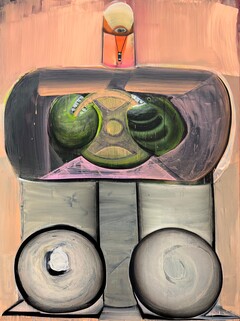
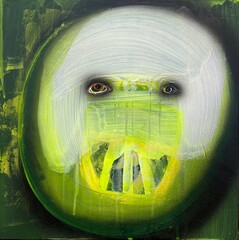
A painting is a skin. I often enjoy observing the distinct choices each artist makes when shaping this skin. One artist chooses fine lines, while another’s are rugged and coarse. One employs broad, sweeping strokes, while another uses delicate, dense fragmentation. Some artists attack the canvas with brushes as blunt and rusted as a dull blade, while others move with the lightness of a breeze, their brushes like sharp willow leaves, gently peeling back layers of color. One artist creates soft, clear edges, where colors transition silkily to the rhythm of an airbrush; another leaves edges that are solid and rigorous, with color boundaries that are distinct, dazzling, and saturated. Some works possess a strange, eerie vitality, while others are so tender and temperate that they melt the horizon, dissolving everything into a blurred expanse. These formal languages—do they not harbor the artist’s identity, their geographical environment, their educational background, and the raw, visceral experiences of their daily lives? When these elements are directly applied to the "skin" of the painting, they forge distinct worlds. What, then, are the parts of this process that can be discussed?
On a sultry, humid evening, carrying these questions with me, I stepped into the hair salon I frequent. I caught a glimpse of the signboard: four large characters, Sui Xin Suo Xing (随心索型). "How marvelous!" I mused. I pondered the phrase carefully, wondering: could our understanding and selection of formal expression be the manifestation of an artist's inner source? Could it be the result of the artist using their brush like a pair of scissors—a "Super Cut" performed at the whim of the heart?
By Jiang Xiaoyu
More Pictures:




 Facebook
 Instagram
 WeChat 微信