
Project TANK Shanghai, Shanghai

Midas asked Dionysus to grant him a wish: that everything he touched would turn to gold. Stones, trees, furniture, even food retained their original forms, yet entered a different scale of value. As gold gradually came to cover everything, the gift revealed its contradiction: if all things could acquire the same precious surface, what would remain of the distinctions that once separated them?
"Gold" runs throughout the exhibition. It possesses weight and price, while carrying a long history bound to currency, courtly ornament, and power. When "gold" covers an ordinary object, what changes first is the way it is seen. This attention to surfaces also grows out of Li’s longstanding observation of the transplantation of European architectural and classical decorative forms in Chinese cities. As columns, ornamental motifs, and courtly styles leave their original historical settings and enter residential and commercial spaces, the idea of the “French” gradually becomes a reproducible visual imaginary, carrying expectations of wealth, taste, and an ideal way of life.
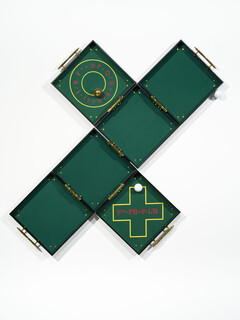
Another scale appears more objective. Measurement places different things within a common system, while games produce outcomes through position and rules; crowns and heraldic emblems once distinguished identity and rank in another way. Here these systems intersect, allowing value to move between measurement, rules, and visual judgment. A similar transformation takes place within the image. Through successive generations, a potato is modified and replaced, gradually approaching a recognizable portrait of a monarch. An image of power once constructed through dress, posture, and the conventions of portraiture is now reorganized by an algorithm. “Coronation” unfolds through a sequence of minute changes, as an ordinary object slowly approaches an ideal form already established and recognized.
Midas’s touch is thus dispersed throughout the exhibition. A layer of ornament or a set of rules can be enough to alter an object’s position. Perhaps what Midas ultimately transformed was never only the things he touched, but the scale by which their value is measured.
Text by Li Hainan
More Pictures:




 Facebook
 Instagram
 WeChat 微信
