
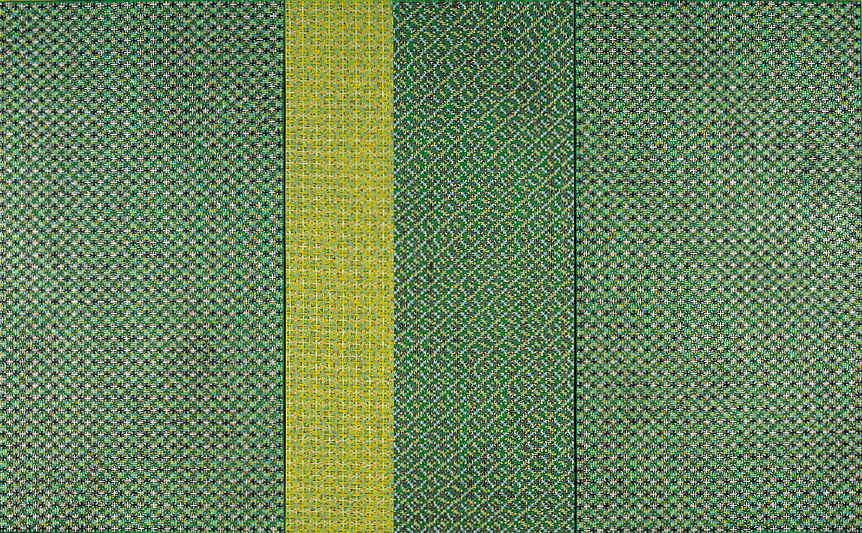
Ding Yi constructs paintings with a unique method. He begins with a tartan check ground, then brushes colors over it repetitively in a regular overlapping pattern. Traditionally, the creation of a relationship between figure and ground is the chief principle of the creation of pictorial space. In this paradoxical approach, however, this relationship is prepared beforehand as an all-over grid on the canvas support, and the subsequent painting follows the same pattern. By abandoning all the rich possibilities of painting at the outset, Ding limits his task to repeating and confirming the pattern that is originally set as a given condition. This extreme self-restraint seems to be the only principle of this painting.
In this sense, Ding's work might be seen as a continuation of the kinds of systems of mechanical repetition found in minimal art. Also, from a certain point of view, it might be related to the postmodern method of using the images of mass-produced products without adding anything new. However, when confronted with the large surface of the actual works, the viewer is moved in a way that is incongruent with such an analytic view. These works express a profound sense of pictorial space as such.
In spite of their extreme regularity, these paintings are marvelous combinations of vibration and chaos. The intricate patterns are all painted freehand, sometimes in dozens of layers, so there are slight discrepancies from the original pattern everywhere. Ding Yi creates an elegant space with a method that represents an extreme in the systematic application of paint with a brush, but the labyrinth of tremulous, dancing color has a trance-like effect.
Kawamoto Shinji. Yokohama 2001: International Triennale of Contemporary Art [M]. Yokohama Triennale Organizing Committee, 2001: 189.

 Facebook
 Instagram
 WeChat 微信